

![[VIDEO] Corvette Shootout Round 2: 1967 427 vs 1965 LS3. Which is Better?](https://www.corvetteblogger.com/images/content/2025/11/111525_13.jpg)
Two Corvettes. Two philosophies. One dyno to settle it all.
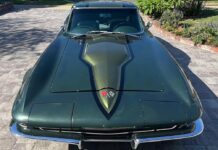
In one corner, wearing Goodwood Green and attitude: a numbers-matching 1967 427 that’s been earning its battle scars on the track.
In the other, dressed in Nassau Blue with a secret under the hood: a restomod 1965 that looks period-correct after being dug out of a garage, that is until you pop that hood and find a crate LS3 where the small block should be.
“We’re going to compare them on the dyno, drive them, possibly race them side by side,” the guys at Horsepower Depot plan. But as with all good automotive shootouts, the cars had their own ideas about how this would play out.
![[VIDEO] Corvette Shootout Round 2: 1967 427 vs 1965 LS3. Which is Better?](https://www.corvetteblogger.com/images/content/2025/11/111525_14b.jpg)
The ’67 is Ryan’s weapon of choice at factory stock races, where it’s carved out a reputation as a consistent mid-12 second bruiser. With its 427/400 horse V8 bored .060 over, a slightly rowdier cam, and bumped compression, it’s the automotive equivalent of a linebacker—all muscle and barely contained violence. Those 4.56 gears out back mean business, and the time slips in the glove box prove it: 12.01 at almost 118 mph.
The ’65 tells a different story. Born a small-block AC car, it’s been transformed multiple times, in its latest metamorphosis becoming a thoroughly modern hot rod wearing vintage clothes. The GM Performance LS3 crate motor hides behind factory rally wheels and redlines, while a built 4L60E handles the shifting duties. Wilwood brakes hide behind the factory Rally wheels, and an ingenious electric power steering system maintains the period-correct look while delivering modern feel. With 4.10 gears and every creature comfort, it’s built for the customer who wants yesterday’s looks with today’s reliability.
On the dyno, the ’67 goes first, and immediately reminds everyone why valve seal maintenance matters. Through clouds of smoke that had the crew’s eyes watering and jokes flying about checking the oil level, the big block laid down its authority: 439 horsepower at 6,000 rpm before falling off.
“I thought it was on fire,” someone coughs through the haze.
![[VIDEO] Corvette Shootout Round 2: 1967 427 vs 1965 LS3. Which is Better?](https://www.corvetteblogger.com/images/content/2025/11/111525_15b.jpg)
Then comes the LS3’s turn. The owner, Craig, had bet $100 it wouldn’t crack 400 horses. The Holley Terminator X-controlled mill had other ideas, spinning up smooth and clean to 400.3 horsepower—just enough to win the bet and prove that sometimes, less displacement doesn’t mean less fun.
On paper, the big block should dominate. At 440 cubic inches with 12.5:1 compression and a diet of 110 octane, it’s giving up nothing. The LS3? A mere 376 cubes, 10:1 compression, perfectly happy on 93. Yet the power gap wasn’t the chasm you’d expect—that automatic transmission’s torque converter eating some power the manual trans car didn’t lose.
But numbers only tell part of the story.
Behind the wheel, these cars couldn’t be more different. The ’65 drives like a modern performance car trapped in a classic body. That electric power steering, dialed in just right, makes highway cruising effortless. Even though the gears are automatic, he says it’s still fun to drive, mashing the pedal to show why. Even on cold November Indiana pavement, it’ll chirp the tires in third.
“If it survives the Jordan test, it works – almost anybody can drive it,” comes the verdict.
![[VIDEO] Corvette Shootout Round 2: 1967 427 vs 1965 LS3. Which is Better?](https://www.corvetteblogger.com/images/content/2025/11/111525_16.jpg)
The ’67? That’s a different animal entirely. Bias ply tires, worn-out suspension, and 50-year-old driving dynamics mean it “drives like crap.” The shifter requires authority. Miss a shift and that MSD box rattling around in the glovebox might be the least of your worries. But when you nail that shift, when you keep those skinny tires hooked up through sheer willpower and clutch slip, when you smell that burnt oil and hear that big block roar—that’s when you understand why Ryan’s been 12.01 in this thing.
They never got their side-by-side race. The cold roads and lack of traction made that a non-starter, which might be for the best—someone would’ve had to fix whatever broke.
In short, the ’65 represents the future of classic cars: modern reliability wrapped in vintage style, ready to cruise or bruise at the twist of a key. The ’67 embodies everything we love about the past: raw, unfiltered, demanding your full attention and rewarding you with an experience no modern car can replicate.
Both approaches work. Both make power. Both make memories.
Which do you prefer?
Source:
Horsepower Depot
Related:
[VIDEO] Horsepower Depot Rescues a ’67 Pro-Tour Corvette Flooded During Hurricane Helene
[VIDEO] Saving a 1972 Corvette Flooded by Hurricane Milton
[VIDEO] 1967 and 1969 L88 Corvettes Tear Up the Track at Edgewater Motorsports Park
Subscribe Now:

Gotta love the classics,but…
Some years ago I had the ‘privilege ‘ of owning a new C4 with a Lingenfellter build out engine and at the same time 1967 Shelby GT 500.
Both cool to own. 1 was always fun to drive. The other, well fun for a cruise and back into the garage it went.
The expression ‘time marches on’ is never more valid then when applied to cars.
Some of us have great memories, but new really is more livable. Can anyone remember the last time you saw a car more than 25 years old on the highway other than maybe car show day?
At 75 I am an old Geezer. but remember with fondness Street racing late 60’s early 70’s with my Ram air 4 firebird thinking I was fast until I met a 67 427/400 and getting my ass kicked. Oh, those days especially Friday nights at the burger joint, big motors, big burn outs and lots of girls. Today I drive a C8 Z06 and leave the burnouts to those memories (well mostly). Times have changed and the 60’s were the best. But I would take either one of these cars in my garage anytime.
There’s nothing like a built 427 with a manual. He should go through the suspension and run modern rubber. Add PS and PB as they make a huge difference. Why own such a beautiful car and not have it in prime condition. As far as the other vette goes, it’s beautiful too but what’s the point if the driving experience is so domesticated that you lose the soul of the car.
Comments are closed.