

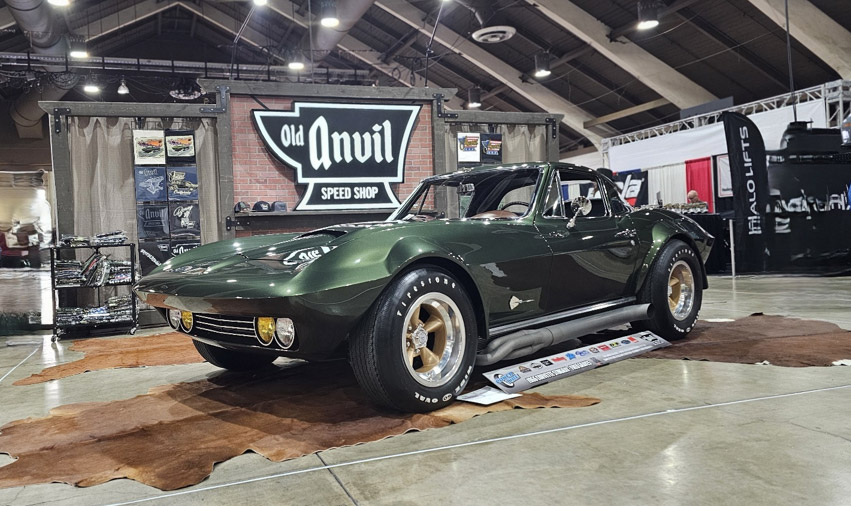
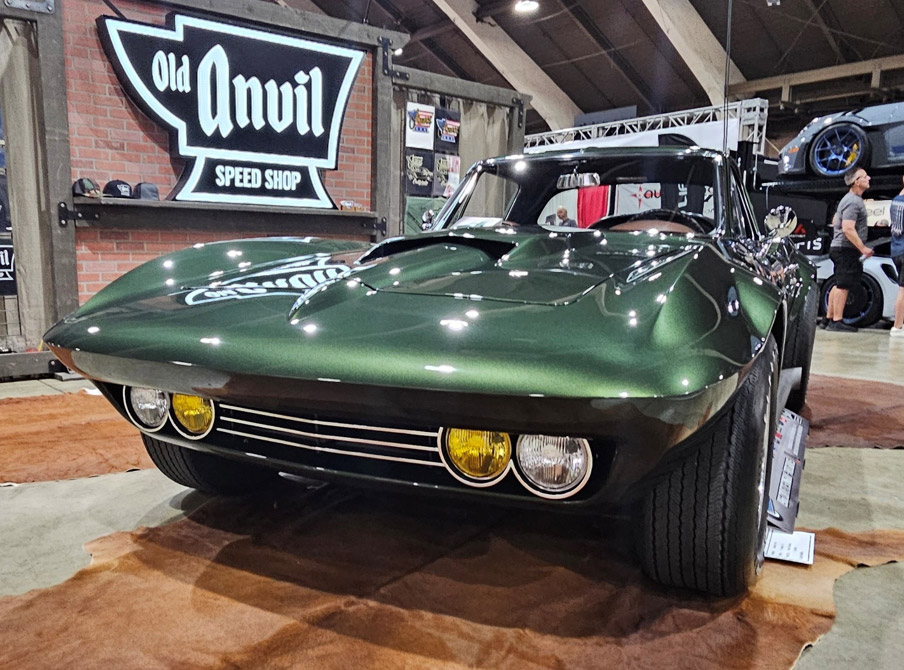
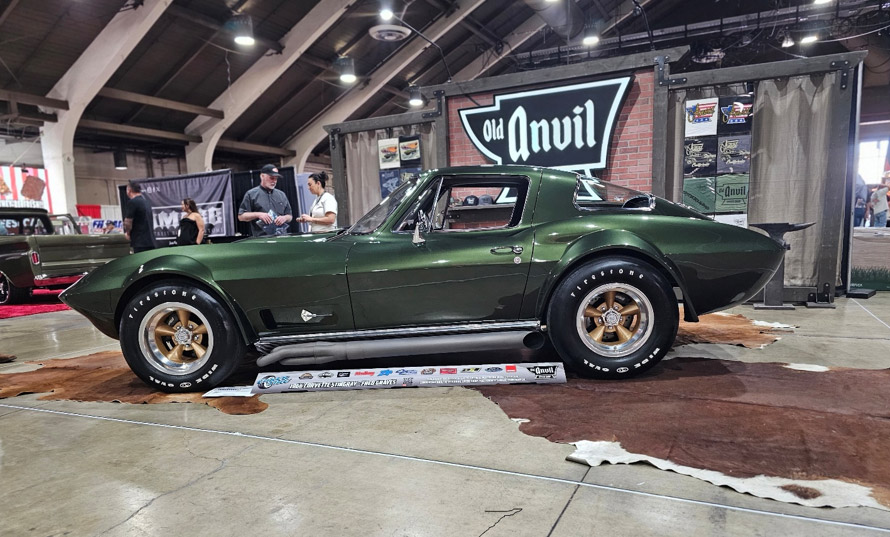
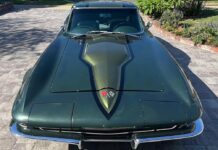
While walking the aisles of the 2026 Grand National Roadster Show in Pomona last month, I spotted a deliciously cool C2 Corvette coupe that felt like a stowaway from the golden age of Seventies custom cars. Think Zora Arkus-Duntov, Led Zeppelin, bell bottoms, American Racing wheels, and metal flake paint imprinted onto the fiberglass curves of Larry Shinoda’s C2 masterpiece. This shamelessly flared 1966 coupe hits every nostalgic note in perfect harmony. Built by Paul Bosserman and his team at Old Anvil Speed Shop in Orange, California, it held court under the lights in Building 4 at the Pomona Fairplex.
There’s an old adage that says you can’t go home again. It’s about the younger version of you that once lived in a certain place, a certain era, a certain frame of mind. Once life moves forward, the door rarely opens the same way again. For owner Fred “Digger” Graves, a Vietnam veteran and retired Los Angeles fire captain, the two-year resurrection of his battered ’66 coupe offered something rare, a chance to step back into a moment he thought was gone forever.
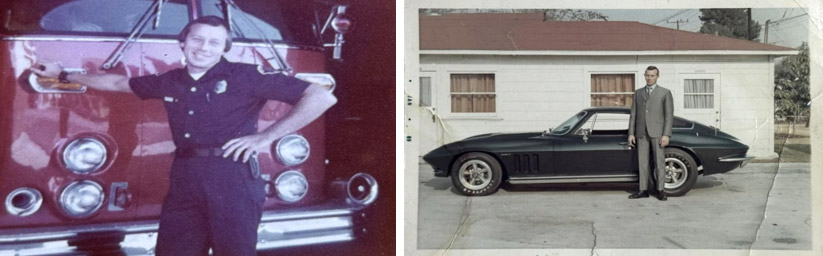 Photo Credit: Fred Graves
Cars usually don’t get a second chance either. Most live hard lives, fade slowly, and eventually disappear into the great boneyard in the sky. This Corvette took a different path. After years of sitting forlorn and wounded, it returned to the road with even more soul than it carried the first time around.
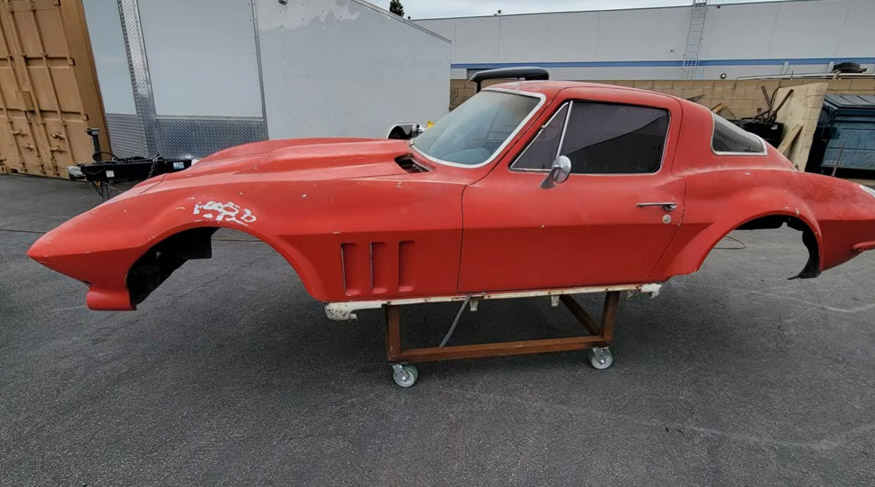 Photo Credit: Old Anvil Customs
The old ‘Vette that rolled into Old Anvil Speed Shop was tired, cracked, and sagging, a once-proud C2 that had been driven hard for decades before being sidelined. Graves had owned the car since the late 1980s and he drove it until the fiberglass gave up, the flares began peeling away, and the body became brittle. Still, he never let it go. For him, the car was a thread back to the moment he returned home from Vietnam and bought a green C2 Corvette, a car long gone but never forgotten.
When the time finally came to bring his current ’66 back to life, Graves didn’t want a museum restoration or a modern restomod filled with superfluous technology. He wanted the old feeling back, built by someone who understood that notion. That someone was Paul Bosserman at Old Anvil Customs.
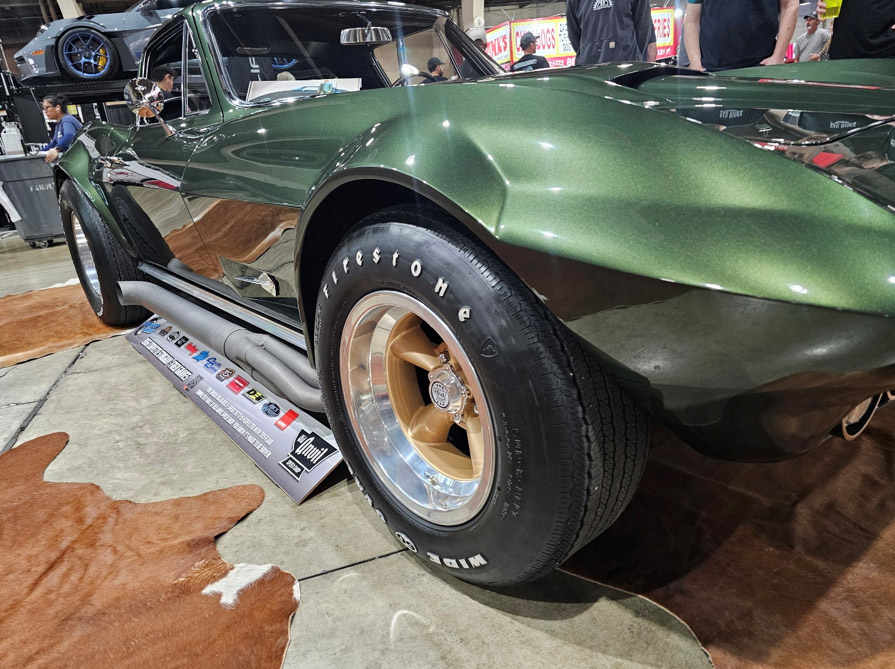
Bosserman started where every great build begins, with a stout foundation, retaining the factory frame while rebuilding the chassis with carefully selected upgrades. Suspension components from Van Steel form the backbone of the setup.
“There’s no feeling like a Corvette independent rear,” Bosserman said. “They used this geometry from 1963 to 1987. That’s how well it worked.”
The rear suspension received larger half-shafts, new bearings, a fiberglass monoleaf spring, QA1 shocks, and a True Trac differential to keep the power planted.
Up front, the philosophy remains the same. Global West control arms with free-moving bushings and QA1 coil overs allow the car to sit low without compromising the way it moves.
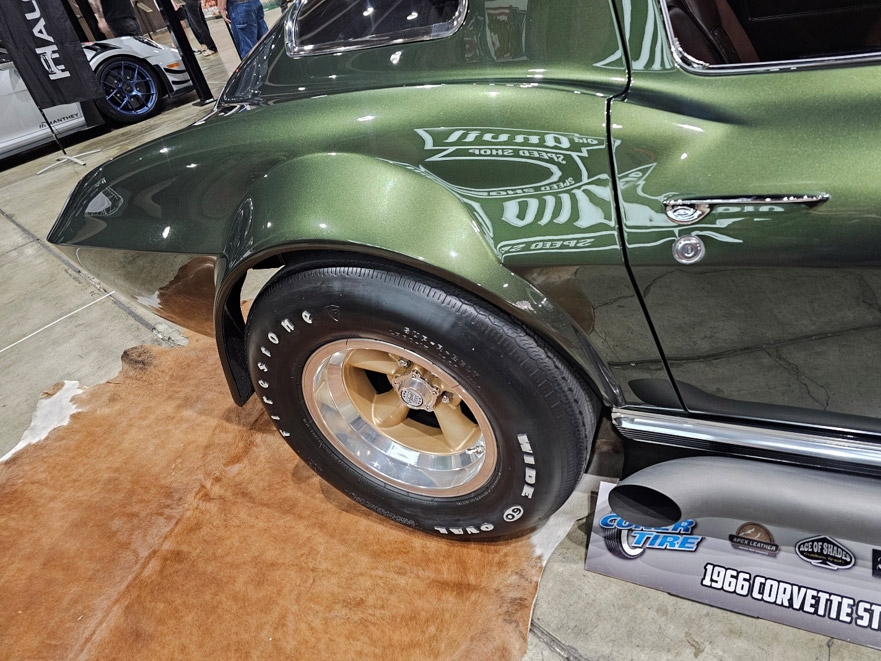
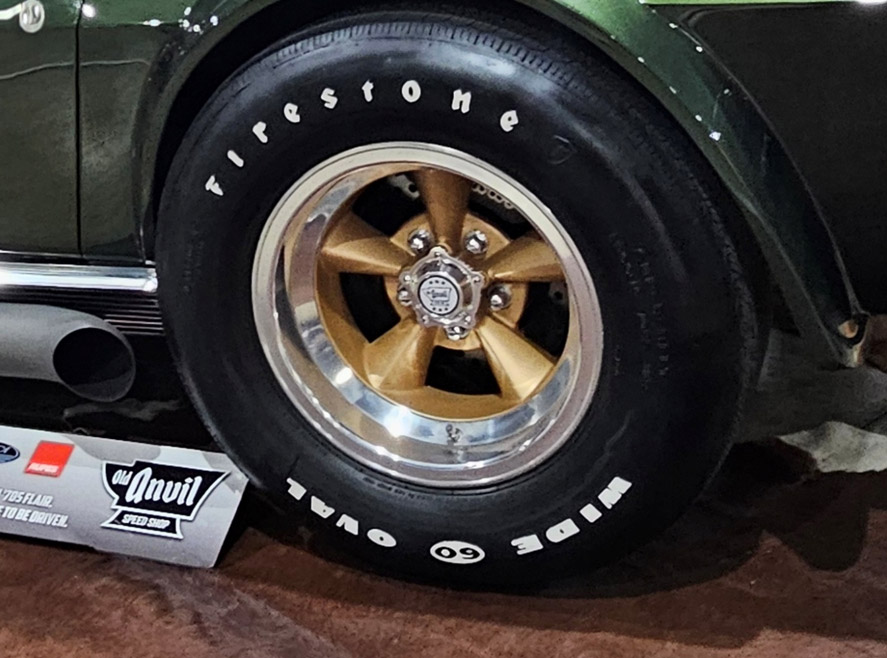
Stopping power comes from manual Wilwood brakes with a 15/16-inch master cylinder and a custom Old Anvil-machined adapter that corrects the pedal ratio. Steering is handled by a Borgeson quick-ratio power box, tight and responsive without feeling artificially modern. The wheels and tires are a love letter to the era Graves remembers. The car rides on genuine 15×8.5 American Racing wheels, vintage rims restored specifically for the build. The tires are Coker’s Wide Oval radials, designed to capture the look of period bias-ply rubber while delivering modern road manners.
To get the stance exactly right, Old Anvil aligned the finished chassis and built fixtures from the wheel centers, allowing the fender radiuses to be cut with surgical precision. The resulting flares are aggressive but honest, echoing the spirit of the 1960s Grand Sport Corvettes without copying them outright. The heartbeat of the car is a GM crate 454 big block that had been sitting in a neighbor’s garage for years before Bosserman resurrected it. Paul estimates the engine now produces roughly 450 horsepower, though the number is almost beside the point. What matters is the big block torque, the kind that makes a 3,100-pound Corvette feel eager at any speed.
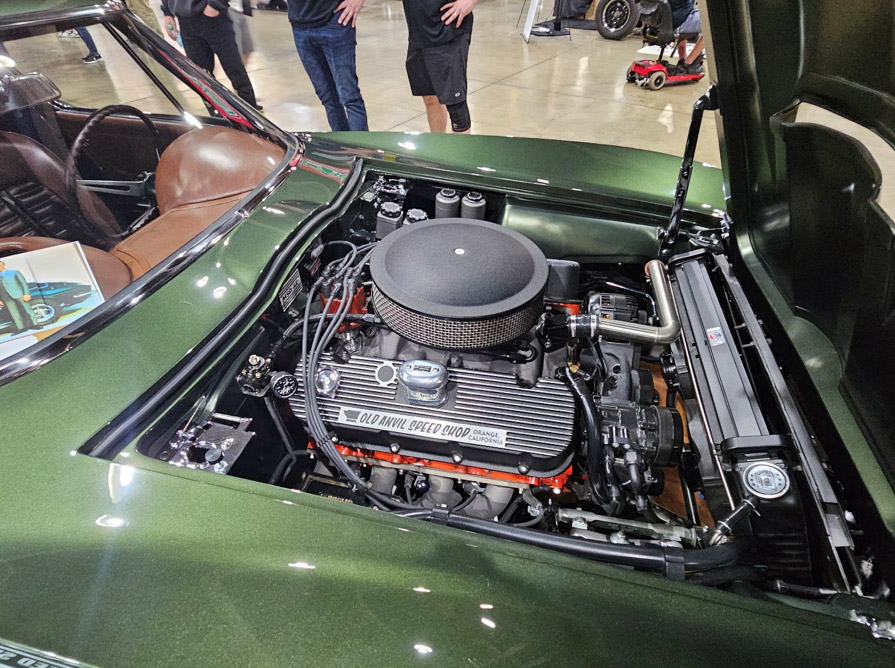
The big Rat motor breathes through Holley’s Terminator X fuel injection and a stealth throttle body fitted with four 100-pound injectors. All that torque flows through a TREMEC TKX five-speed transmission and a set of 4.11 gears.
Under the hood, nothing is hidden. “I don’t like to hide all the hoses and do all that show stuff,” Bosserman said. “Why not just bring it all out and use really high-quality parts? Besides, it’s easier to service later.”
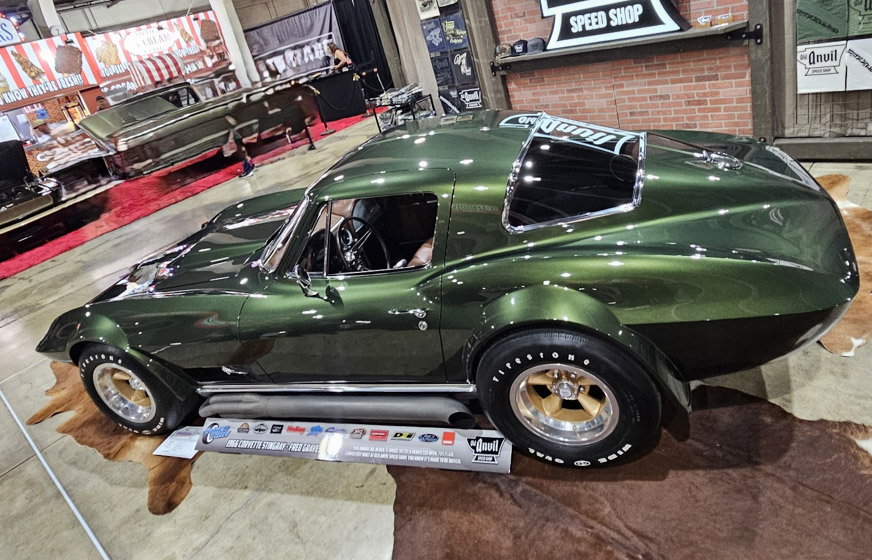
The bodywork is extensive but restrained. The hood began life as a 1967 cowl-induction piece before being extended and smoothed so the cowl vents disappear and the lines flow uninterrupted to the windshield. At the rear, the tail panel was reworked into a single piece with six taillight housings fabricated in-house. Look closely and you’ll notice the razor-sharp finishing of the body lines. The color is a homage to the 1970-only Donnybrook Green, but with an added skosh of multi-hued, metallic shimmer.
Chrome remains exactly where it belongs, door handles, trim, and accents, because Old Anvil never subscribed to the monochrome trend. “I like playing with textures,” Bosserman said. “Just to make it stand out a little bit.”
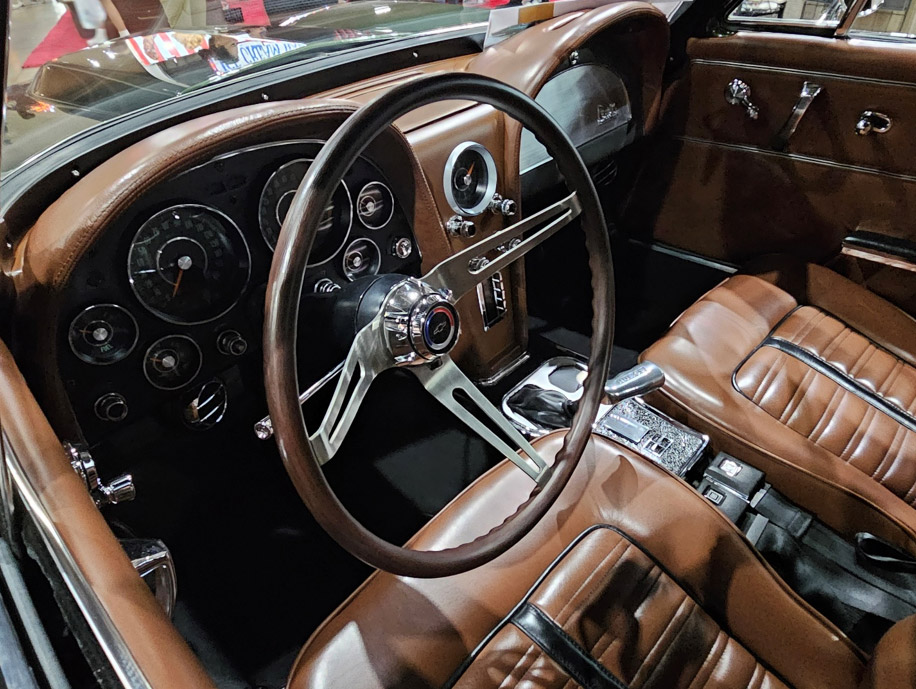
Inside, the car is a study in restraint. The seats retain factory-style foam wrapped in Apex leather with just enough natural sheen and imperfection to feel authentic. Rather than chase the stretched, rock-hard look of many modern show interiors, Bosserman aimed for something that felt closer to the original spirit of the car.
German loop carpet replaces the factory material, tighter and more refined than traditional square weave. The gauges are Dakota Digital units designed to mimic the original analog sweeps, while a modern stereo hides behind a RetroSound faceplate.
Even the large, thin-rim steering wheel remains in place for now, framing the gauges exactly as it did decades ago. Eventually Graves plans to install a smaller wheel to make the car easier to maneuver as he continues dealing with injuries from his years in the fire service.
Perhaps the most remarkable part of the entire build is that the Corvette never left Old Anvil’s shop during the process. “Every piece of machining, fabrication, upholstery, wiring,and assembly happened under one roof. It never saw daylight until we backed it out of the trailer at its SEMA 2025 debut, Bosserman said.
Some people spend their lives chasing the past. Fred Graves found a way to drive back towards it. And while the old saying insists you can’t go home again, sometimes, if you’re lucky, a Corvette can take you pretty close.
Source
GNRS Photo Credits: Dave Cruikshank
Related:
Modern Magic: 1963 SPEC-V Corvette by Heartland Customs
[VIDEO] 1963 Corvette Split Window Restomod is Further Transformed into a 580-hp Widebody Beast
[VIDEO] Peter Brock Unveils his Studio Concept Corvette at SEMA 2024
Subscribe Now:


Crazy how flares can so dramatically improve the look of the C2.
Well,. I’m just not sure about this. It definitely is a throwback to the late sixties and seventies when we did this to Vettes because they were relatively cheap. I will admit that I cut the wheel wells on my ’65 L-79 roadster with a Saw All. But just because you can doesn’t mean you should. One thing I will say about this is that Anvil did an awesome job. I guess that time has changed me. I currently have a 2000 FRC and with the exception of Flow master exhaust I have done everything I can to keep it original.
Nice old school style build.
Cool car!
Comments are closed.