

Even though the Corvette didn’t earn a model level award in the 2026 JD Power U.S. Initial Quality Study, Chevy’s flagship sports car may still benefit from the brand’s overall performance—one that keeps the Bowtie solidly above the industry average.
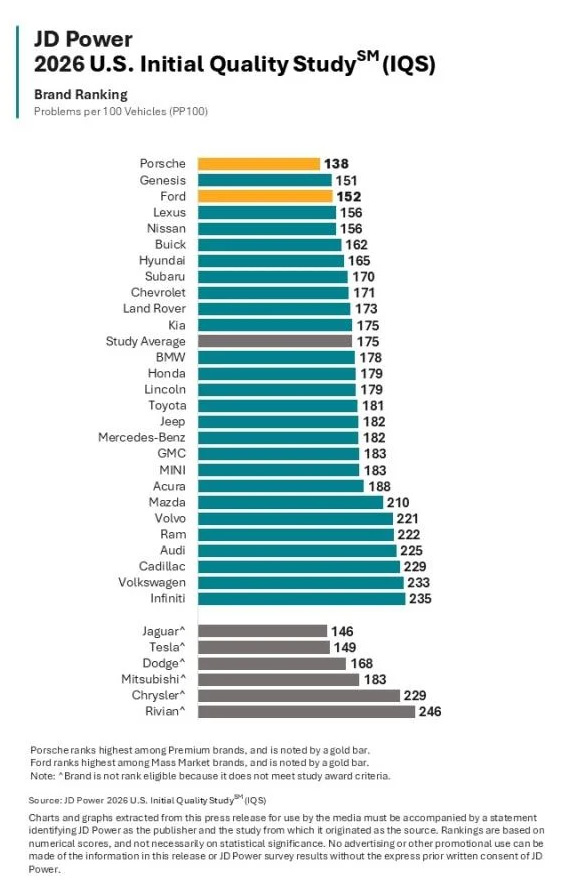
Chevrolet posted 171 problems per 100 vehicles (PP100), landing ninth among mass market brands. That’s a step down from last year’s fifth place finish, but still ahead of the industry’s improving average. And while the Corvette wasn’t singled out this time, the study suggests that Chevy’s broader quality gains could ripple across the lineup, including its halo car.
The competitive landscape shifted sharply this year. Ford surged to the top of the mass market rankings with 152 PP100, leapfrogging rivals and tightening the race in a segment where software, connectivity, and user experience increasingly shape owner satisfaction.
JD Power’s study—based on owner feedback from the first 90 days of ownership—showed the strongest year over year improvement since 1997. The industry average dropped from 192 PP100 to 175, a sign that automakers are finally addressing long standing quality issues. But technology remains a sticking point. Infotainment was the only category to worsen, with Apple CarPlay and Android Auto connectivity problems dragging down scores.
As JD Power’s Frank Hanley put it, “The biggest gains in quality come from features that are easy to use—simple controls, less intrusive driver assistance and software that works the way customers expect.”
For Corvette fans, that message hits close to home. The C8’s mid engine layout, advanced electronics, and performance focused systems rely heavily on software integration. Improvements in Chevy’s corporate wide quality—especially in tech—could translate into a smoother ownership experience for future Corvette buyers.
General Motors earned four model level awards this year, including wins for the Chevy Blazer and Tahoe, along with Cadillac’s CT4 and XT5. While the Corvette didn’t join that list, Chevy’s continued strength in key segments reinforces the brand’s overall competitiveness.
The 2026 study collected responses from 78,514 owners of 2026 model vehicles between June 2025 and May 2026. And as the market shifts toward software heavy vehicles, the Corvette’s long term success may depend as much on digital refinement as mechanical excellence.
For now, the Corvette remains the emotional centerpiece of the Chevy lineup—one that stands to gain from every incremental improvement the brand makes.
Source:
jdpower.com
Related:
Chevrolet Ranks High on J.D. Power’s 2026 U.S. Vehicle Dependability Study
2026 Corvette Wins J.D. Power’s U.S. ALG Residual Value Award
Chevrolet Corvette Scores First Place in J.D. Power 2025 Vehicle Dependability Study
Subscribe Now:




But most of the service departments suck.
All this means is that Ford’s problems start to show up after 90 days. Ford, these days, stands for Fix or Recall Daily.
Today’s Corvette technology has generally stuck to basics which probably helps keep problem reports down. It doesn’t have some of the software “toys” found in Cadillac, Tesla and even some high end SUVs and trucks. No self parking. No adaptive cruise control. It’s puzzling. I would like such features, but if they introduce new problems, I’m ok with what we have. I can “rough it”. Regarding the Infotainment Center, I prefer the radio screens that I had in my 2024 Stingray to the one in my 2026 ZR1. From an ergonomic standpoint, it was much easier to select and group stations. Not everything newer is better.
Comments are closed.