

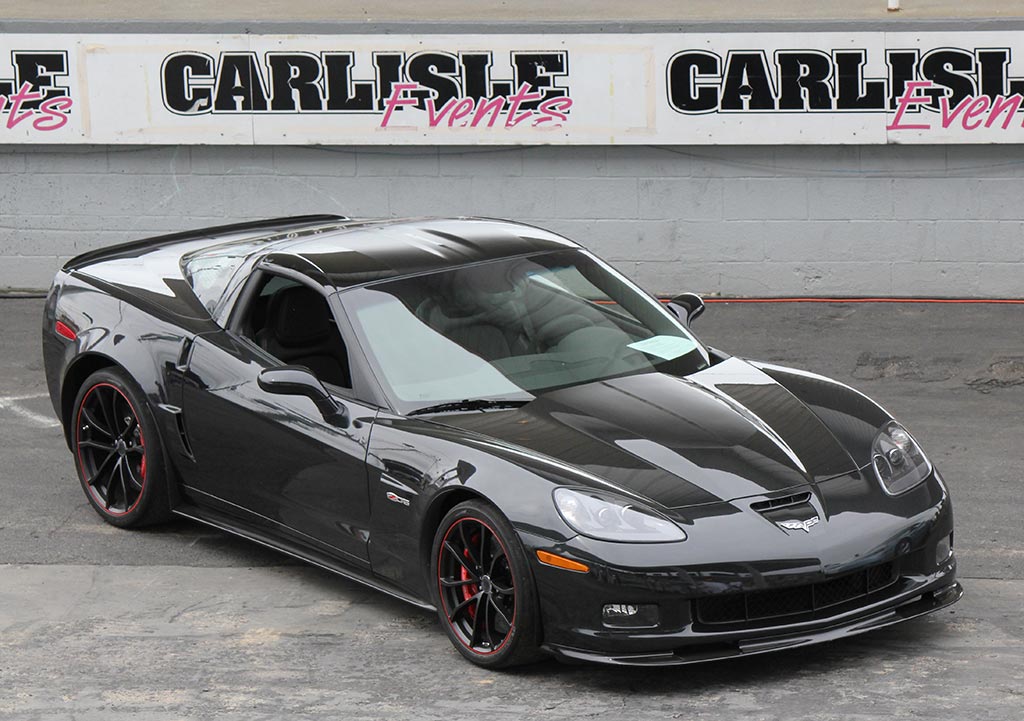
For nine years now, the automotive investment and valuation experts at Hagerty have been putting together an annual roundup of the vehicles they think are most likely to be worth the most by the time the next edition is posted, vs. where they stand today. The agency’s primary focus when putting together Bull Market is value, specifically cars that seem to be undervalued and starting to be noticed by the market at large, which always leads them to recommend an eclectic group of vehicles.
The last time a Corvette found its way to the list was in 2023 with the recommendation of the C5 Corvette Z06. Since then, 2001-2004 LS6 ‘Vettes have seen “#1: Concourse” grade examples rise from an expected value of $49,300 to $62,300 (+26.4%). The much more common 2’s (“excellent” condition) have shown more modest gains from $34,300 to $39,100 (+14%), and grades 3 and 4 (anything that presents from “good” down to “fair”) have remained mostly flat, with the nicer stuff hovering around $25,000 and rougher examples expecting to fetch under $14k. It’s not an exact science, but as they deal mostly in the 1-2 range, we’d say they correctly called their shot on the C5Z! For 2026, Hagerty is again at home plate, pointing over the left field fence, but this time, it’s with the even burlier successor to the mightiest C5 in mind!
While almost every other performance vehicle around the globe has suffered engine shrinkage over the last two decades and tried to make up for it with the little blue pill of turbocharging, Corvette customers have been spoiled. The 5.7L displacement found under the long swooping hood of ‘Vette’s spanning from the Moon Landing through the launch of Google Maps was bumped to an even 6.0 for the C6, then expanded again to 6.2L for a 2008 refresh, where it has remained the picture of consistency through two more generations of America’s Sports Car.
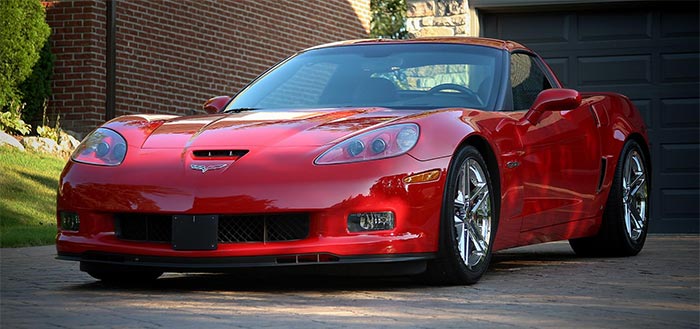
And, until the rumored 6.6L V8 debuts, 6.2L – 376 cubic-inches – is as much displacement as you’re going to find in a modern Corvette… unless you get that one. Before turning to superchargers, then exotic flat-plane crankshafts, electrified front axles, and massive twin-turbos to find the extra power that customers demand in the higher-end parts of the lineup, the Corvette team crafted the singular C6 Z06. In 2006, one “Small” Block V8 was allowed to go all-in with the classic “no replacement for displacement” horsepower playbook, and the outcome was glorious!
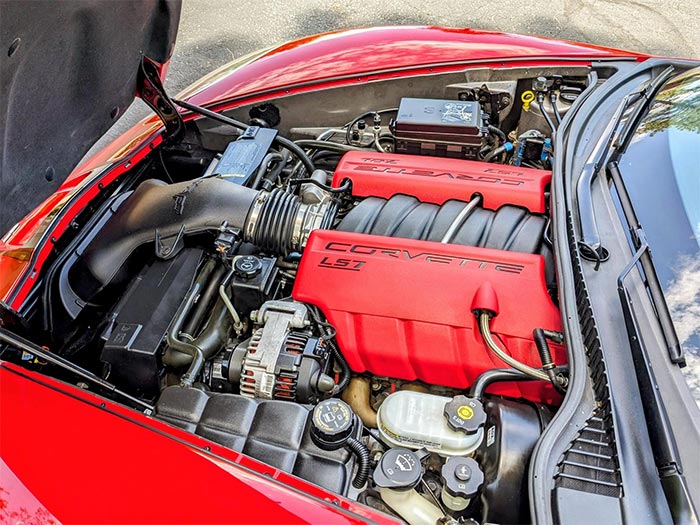
For the resulting LS7 V8, GM powertrain engineers crafted a 7.0-liter masterpiece. The hand-built, dry-sump, aluminum 427 ci beast maxed out at 505 horsepower and 470 lb-ft of torque while revving to a lofty 7,000 RPM. Without the aid of forced induction, the C6Z’s horsepower and redline records would take 17 years, an extra camshaft, and a 180-degree crank to overtake, while the torque figure has only been tied (2020+ LT2).
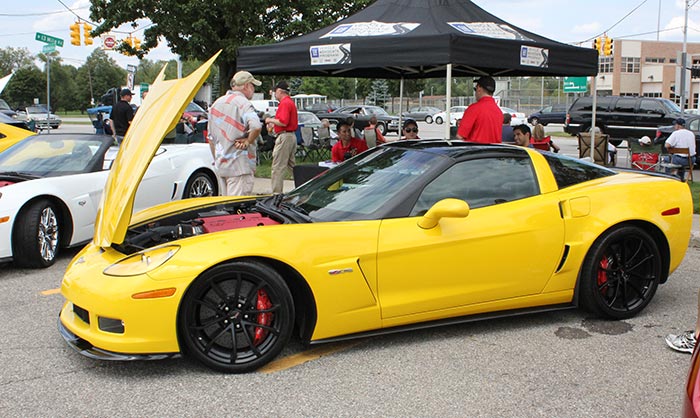
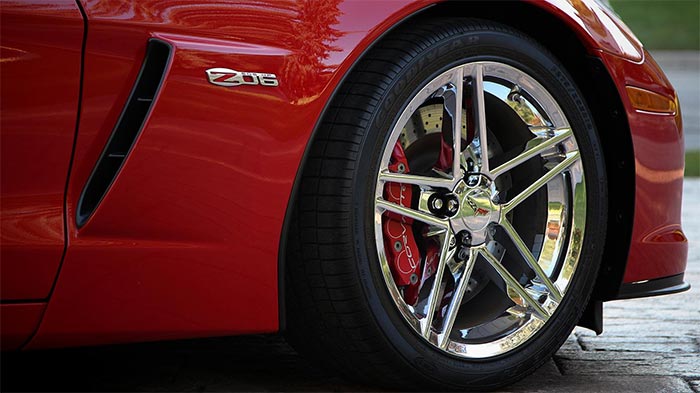
While the LS7 was the heart and soul of the operation, it was far from the only thing that made the 2006-13 Z06 an all-time great. An all-aluminum frame joined forces with a magnesium roof and engine cradle, carbon fiber fenders, and balsa wood floorboards to get weight down to just 3,288 pounds. Those lightweight fenders were also widened to cover beefier rubber and upgraded brakes, the driveline components were fortified to cope with the output at play, and a manual transmission was the only option.
After his first test with the Z06, Hagerty’s Larry Webster, then with Car and Driver, summed up the first in a string of Super ‘Vettes perfectly: “It ripped to 60 mph in only 3.6 seconds, hit 100 in 7.9, and 150 in 17.5. That’s on par with or better than the performance of the $153,345 Ford GT (and good luck getting that price) and $180,785 Ferrari F430. Likewise, the brakes are terrific, bringing the Vette to a standstill from 70 mph in only 162 feet. And it pulled 0.98 g on the skidpad. Spending double the Z06’s price does not guarantee you’ll have a car that can beat it.”
Unlike the Ford GT and Ferrari quoted by Webster, Chevrolet believes the supercar should be a proposition for all who want it, and they proved it by building 27,995 examples of the C6Z over an eight-year life span. That lack of rarity has kept values relatively low, especially when you consider the massive performance at play – even by today’s inflated standards – but values are already rising. Conditions 1 through 3 are all up more than 8% since October of 2024, with current expected asks of $75,300, $53,500, and $37,200, respectively. #4 Fair Condition cars lag the rest of the group in both current value and growth, up just 5.3% to $26k over the same time span.
Ten other vehicles expected to make the most gains over the next year hail from all corners of the developed world and were in showrooms as far back as 1956, with the C6 Z06 representing the newest member of the club. The 1990-93 Chevy SS 454 truck is the other GM product on the list, and fellow Americans take up another three spots with the Mark II Lincoln Continental of ’56-’57 and a pair of Dodges – the ’81-93 Ramcharger (which is notable as the only vehicle not geared for street use after several years of white-hot 4x4s) and the ’68-’70 Charger. Germany earned three spots with the V10-powered E60-generation BMW M5, the Porsche Carrera GT, and the VW Golf GTI VR6. Japan earned a pair of spots on this year’s list with the second-gen “NB” Mazda Miata and the “R33” generation of the Nissan Skyline GT-R. Finally, the Alfa Romeo GTV is the lone Italian this time around.
If you have the means to look at cars as investments, these are your best bets when trying to “buy low.” As far as the Corvette with the monster motor is concerned, we’d add that Special editions and juiced Z07 versions can push those values even higher, so if you want to hop on a boat before the tide continues to rise, there’s never a better time than now!
Source:
hagerty.com
Related:
[VIDEO] This C6 Z06 Was Going Bonkers Until the Owner Asked ChatGPT for Help in Fixing It
This Unique 2009 Corvette Z06 Kart Headed to Mecum Kissimmee was Made to Resemble a ’63 Split Window
[VIDEO] C6 Corvette Z06: The Best Ever? (Canyon Drive Review)
Subscribe Now:
![[VIDEO] 1963 Corvette Split Window Restomod Named 'Redline' Sells for $418,000 at Barrett-Jackson Las Vegas](https://www.corvetteblogger.com/images/content/uploads/2026/10/102126_10-218x150.jpg "[VIDEO] 1963 Corvette Split Window Restomod Named ‘Redline’ Sells for $418,000 at Barrett-Jackson Las Vegas")
![[VIDEO] Teen Corvette Driver Crashes into Two Vehicles and is Pitted in High Speed Pursuit](https://www.corvetteblogger.com/images/content/uploads/2026/10/101426_3b-218x150.jpg "[VIDEO] Teen Corvette Driver Crashes into Two Vehicles and is Pitted in High Speed Pursuit")
![[VIDEO] 1962 Corvette Restomod with an LS3 and 6-Speed Manual Sells for $456,500 at Barrett-Jackson Las Vegas](https://www.corvetteblogger.com/images/content/uploads/2026/10/100626_17-218x150.jpg "[VIDEO] 1962 Corvette Restomod with an LS3 and 6-Speed Manual Sells for $456,500 at Barrett-Jackson Las Vegas")

In 2021 a class action lawsuit: Some C6 ZO6 owners found their Corvette’s to have prematurely worn valve guides. The valve guides issue has been known for some time now, and even GM (Mr. Tadge Juechter) has acknowledge the issue after tracing the problem to one of its suppliers. The LS7 head issue is either a design (valvetrain geometry, valve guide material) or a process (machining) issue. You don’t inspect quality into parts. Quality is a result of good design and manufacturing. Face it Corvette Boggers, the design could not be successfully, reliably executed by the manufacture’s supplier. Therefore, by definition, that equates to a major design flaw of the C6 ZO6 LS7 engine.
(Note: Alex, thanks for mentioning the floor structure is made out of Brazilian balsa wood.)
Many thanks,
Ray
Hey Ray, sorry I’m just seeing your comment (good one, as usual!).
The LS7’s issues are real but in my experience selling ‘Vettes last decade and meeting a ton of C6Z owners, I also think they’re overblown like so many things online. Either way, though, it’s an easy fix. A quick call to Katech can get the engine up to snuff AND upgraded to 550 HP for $7,500 – which, is about $2k more than they charged the last time I checked and might make me second-guess getting it done, unfortunately.
Have a very Merry Christmas!
Comments are closed.